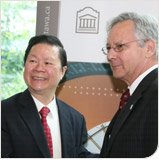
Showing posts with label Christian Detellier. Show all posts
Thursday, July 9, 2015
Christian Detellier suddenly departs after a single term as second boss man at U of O
The July 8, 2015, uOttawa Gazette announced after-the-fact that Christian Detellier's mandate as VP-Academic (second in command below Allan Rock) ended on June 30, 2015: LINK.
Allan Rock will have seen four (4) different second boss mans during his watch: Robert Major, Francois Houle, Christian Detellier, and whoever Rock will name next.
This is the second unannounced sudden departure of a VP-Academic under Rock. Houle was suddenly paid out in mid-mandate over a dispute about the institution's bilingualism, and following the Ann Coulter media fiasco in which Rock hid the truth that he had asked Houle to write the controversial letter of threat to Coulter, until everything was disclosed via access to information as reported by the National Post.
The VP-Academic position tends to be the only position in which Rock can't simply parachute someone in from outside the institution, as he has hand picked everyone.
Detellier's sudden departure, without a search for a new VP-Academic having been announced prior to the departure, follows a June 9th CBC News report that Christian Detellier may have been unfair to students: LINK.
Detellier said: "I have research grants and contracts, including an NSERC Discovery grant, until July 2017, when I will retire." (Gazette)
In any case, word in the halls has it that Detellier was not particularly on top of things, and that the real doer was his chief of staff Ms. Rachel Ouellette.
Monday, June 8, 2015
VP-Academic Christian Detellier and VP-Research Mona Nemer may have been unfair to students -- CBC reports
Published today:
Institute of Population Health to close after uOttawa senate vote
Senate vote on Monday spells end of interdisciplinary health program
CBC News
"This is definitely a pattern of doing things behind closed doors and not fulfilling promises," PhD student Reed Beall told CBC's Ottawa Morning, pointing to a 2014 letter from the vice president of research and vice president of academic programs, assuring students they would be consulted if the decision to cancel the program came around again.
"They've gone behind our backs and gone directly to the senate with this vote today," said Beall, who Beall is one of about 40 PhD students studying topics in epidemiology and health trends at the institute. "They never consulted us and we were promised that in writing."
The VP-Academic is Christian Detellier. The VP-Research is Mona Nemer.
In a statement, the university said the school will still offer a PhD in Population Health.
Thursday, November 28, 2013
Crass language opportunism at uOttawa?
This recent media article, uOttawa cuts fees for international students studying in French, has two Francophone administrators of "Canada's university" -- Belgian Francophone Christian Detellier (VP-Academic) and Quebecois Francophone Gary Slater (Associate VP-International) -- explaining how the University of Ottawa has a statutory duty to help the Franco Ontarian population...
... and how the institution will accomplish this by lowering tuition fees to boost its numbers of international Francophone students... Which, we note, fits nicely into president Allan Rock's steadfast agenda to globalize the institution's mission, without doing anything for Franco Ontarians.
Meanwhile, there are virtually no professors of Franco Ontarian origin among the academic ranks, which the University has historically done little about. The institution has always chosen to import its French, rather than preserve and develop the French culture of Ontario, as it is mandated by the government to do.
The ideal policy assimilation tool of course is "official bilingualism", as is well understood in Quebec, and which has been another Allan Rock initiative for the University -- over which the former VP-Academic appears to have left the ship.
Then again, the Statute also directs "to further, in accordance with Christian principles, the intellectual, spiritual, moral, physical and social development of, as well as a community spirit among its undergraduates, graduates and teaching staff, and to promote the betterment of society."
Christian principles would have the University reduce tuition fees in accordance with financial need, not language or academic achievements, and certainly not to feed geoeconomic ambitions in Africa or elsewhere.
Such is the status of the assimilate (and globalize) versus protect debate at "Canada's university". It's a good name after all.
An Act respecting Université d'Ottawa: "to further bilingualism and biculturalism and to preserve and develop French culture in Ontario"
... and how the institution will accomplish this by lowering tuition fees to boost its numbers of international Francophone students... Which, we note, fits nicely into president Allan Rock's steadfast agenda to globalize the institution's mission, without doing anything for Franco Ontarians.
Meanwhile, there are virtually no professors of Franco Ontarian origin among the academic ranks, which the University has historically done little about. The institution has always chosen to import its French, rather than preserve and develop the French culture of Ontario, as it is mandated by the government to do.
The ideal policy assimilation tool of course is "official bilingualism", as is well understood in Quebec, and which has been another Allan Rock initiative for the University -- over which the former VP-Academic appears to have left the ship.
Then again, the Statute also directs "to further, in accordance with Christian principles, the intellectual, spiritual, moral, physical and social development of, as well as a community spirit among its undergraduates, graduates and teaching staff, and to promote the betterment of society."
Christian principles would have the University reduce tuition fees in accordance with financial need, not language or academic achievements, and certainly not to feed geoeconomic ambitions in Africa or elsewhere.
Such is the status of the assimilate (and globalize) versus protect debate at "Canada's university". It's a good name after all.
Sunday, May 2, 2010
Blast from the past - Five headed dragon vs the truth

Five fingers on a hand, five senses, five great lakes... five science department chairs in the Faculty of Science at the University of Ottawa. That could make the school a five star establishment but well not quite. UofOWatch still has work to do because there is room for improvement.
Back on February 22, 2006, the five chairs
- Steve Perry (Biology)
- Alain St-Amant (Chemistry)
- Keiko Hattori (Geology)
- Michel Racine (Mathematics)
- Richard JW Hodgson (Physics)
boldly co-signed THIS statement that was also published in the student newspaper at the time. The goal of the statement appears to have been to discredit physics professor Denis Rancourt and to cover up the errors of the dean of the Faculty of Science Chistian Detellier.
Professor Alain St-Amant went on to dedicate himself to a serious campaign, a la Dershowitz-Finkelstein, to have Rancourt fired; complete with repeated public accusation of anti-semitism for having invited Palestinian speakers into a classroom, etc. He had to wait for the advent of staunch Israeli policy supporter president Allan Rock before his project could be fully realized. UofOWatch readers will remember the extensive comments from Dr. St-Amant about everything from his low h-index to the true nature of "academic integrity." Eventually, the university was forced to instruct St-Amant to stop his behaviour (and HERE and HERE-G8).
Professor Richard Hodgson went on to fabricate elements of a graduate student complaint against Rancourt as part of an administrative mobbing to have Rancourt removed from the graduate school and is now being sued by Rancourt for his creative contributions.Professor Steve Perry had already expressed his concern about democratizing education earlier in February 2006 to a biology graduate student (and to the great concern of the
graduate student union president of the time) who wanted to ask a German expert who was in town to give some lectures about time-series data analysis applied to biology. Perry blew up and gave her the proverbial "fuck you" ending with "Denis Rancourt casts a long shadow!" Who knows what animates the inner workings of a biology chairman? Dr. Perry went on to be a 2008 recipient of a Royal Society of Canada Award.But we diverge. Let us get back to THIS 2006 letter from the five chairs and, with the the benefit of unfolding events, let us analyze if the chairs were right, let us use time-series analysis.

Let's see. The five chairs said
We, the Chairs of all five departments of the Faculty of Science, firmly believe that the actions taken by Dean Christian Detellier have been done in the best interests of the Faculty and the University.Well. Turns out the university was forced to apologize for Detellier's action of barging into Rancourt's class unannounced to the students on September 21, 2005. See apology HERE. The university does not like to make such apologies. No no it never likes to do that.
What else did Detellier do that the five chairs believe was "in the best interests of the Faculty and the University"? Well he disciplined Rancourt for his pedagogical methods and for his grading method in the 2005 "activism course". That did not go over very well with the labour law arbitrator who ruled on the case.
Let's see. The five chairs put it this way
we are in complete agreement that Professor Rancourt's self-proclaimed "academic squatting" is an entirely inappropriate approach to curriculum change.Well. The arbitrator ruled this way
… the major change being with respect to the pedagogical innovation of independent group studies, the involvement of the students themselves in identifying areas of interest and the introduction of the satisfactory/not-satisfactory grading system. The Arbitrator is satisfied that those pedagogical initiatives were legitimately within the purview of the academic freedom enjoyed by Professor Rancourt …And an independent legal analysis published in a law journal summed it up in its title:
TEACHING SCIENCE THROUGH SOCIAL ACTIVISM IS PROTECTED BY ACADEMIC FREEDOM, ARBITRATOR RULESSo. The five chairs who ran the science departments at the U of O were all wrong. Their only penalty for being wrong will be to be promoted or complimented or retired with honour.
It is therefore only just that we end this post with the following child's song.
Five little monkeys jumping on the bed,
One fell out and bumped his head;
Momma called the doctor, the doctor said,
"No more monkeys jumping on the bed!".
Four little monkeys jumping on the bed, etc.
(until)
One little monkey jumping on the bed,
He fell out and bumped his head;
Momma called the doctor, the doctor said,
"No more monkeys jumping on the bed!".
No little monkeys jumping on the bed,
None fell out and bumped their heads;
Momma called the doctor, the doctor said,
"Put those monkeys straight to bed."
FOR ALL THE BACKGROUND AND CONTINUED MEDIA REPORTS:
Academic Freedom site
Wednesday, December 30, 2009
Grievance Victories Tabulated: From dean Christian Detellier’s “class attack” to chemistry-chair Alain St-Amant’s enthusiasm for exposing the “truth”…
.
The web site rancourt.academicfreedom.ca about the Denis Rancourt case at the University of Ottawa has recently published a chronological summary of all twenty five (25) labour law grievances filed by Rancourt against the University and their outcomes to date >>> HERE.
The grievance and settlement process is exceedingly slow. However, outcomes for some grievances from 2005 and 2006 and one grievance from 2007 have now been determined.
All the grievances assumed by Rancourt’s union have lead to arbitration rulings or settlements or outcomes in favour of Rancourt: Six (6) straight victories >>> see HERE.


Interestingly, in relation to the latter point, St-Amant made a complaint to dean Lalonde against Rancourt. Although the dean never initiated discipline against St-Amant for the chemistry chairman’s quite remarkable and extensive contributions to the “truth”, the dean did initiate a disciplinary process against Rancourt on the basis of St-Amant’s bogus (and incomprehensible) complaint against Rancourt.
During the latter disciplinary process, Rancourt insisted that the required investigatory meeting be recorded and asked to be told by the University in plain language what he was being accused of by the University. Rancourt asked the dean if the accusation was for “unethical behaviour” of the type for which the dean had been obliged to intervene regarding St-Amant. The University immediately dropped its discipline charge without ever clarifying what the discipline was about; despite Rancourt insisting that the disciplinary process foreseen by the rules should follow its course (to prove his innocence).
You can’t even be disciplined when you want to be!
[Photos, top to bottom: Christian Detellier, Alain St-Amant, Andre E. Lalonde, Robert Major, Howard Alper.]
The web site rancourt.academicfreedom.ca about the Denis Rancourt case at the University of Ottawa has recently published a chronological summary of all twenty five (25) labour law grievances filed by Rancourt against the University and their outcomes to date >>> HERE.
The grievance and settlement process is exceedingly slow. However, outcomes for some grievances from 2005 and 2006 and one grievance from 2007 have now been determined.
All the grievances assumed by Rancourt’s union have lead to arbitration rulings or settlements or outcomes in favour of Rancourt: Six (6) straight victories >>> see HERE.

- Dean Christian Detellier’s 2005 “class attack” against the first activism course (see December 2005 YouTube video HERE) resulted in a Memorandum of Settlement in which the University expressed regret for the Dean’s in-class outburst.
- In 2005 dean Christian Detellier falsely alleged the existence of a student complaint about Rancourt’s CHUO 89.1 FM radio show (The Five O’Clock Train) and used this to pursue a contrived disciplinary attack against Rancourt. The University retracted all of its written allegations and its disciplinary venture.

- Dean Christian Detellier formally forbade Rancourt and all professors in the Faculty of Science from using the Satisfactory/Non-Satisfactory (S/NS) grading method in their courses. A Memorandum of Settlement resulted in which the dean’s instructions were withdrawn and the University de facto admitted that the Dean could not violate academic freedom in this way.
- In 2006, the University disciplined Rancourt for his 2005 activism course. The case went to labour law arbitration. The arbitrator sided with Rancourt and a professional and independent legal analysis of the arbitration Award was entitled “Teaching Science through Social Activism is Protected by Academic Freedom, Arbitrator Rules.” See also the UofOWatch report HERE.

- In 2006 the University constructed two more bogus disciplinary campaigns against Rancourt: One about a complaint from teacher assistants regarding a professional criticism made by Rancourt and the other involving unfounded accusations of anti-Semitism from the U of O Jewish Student Association against an invited speaker and professor in Rancourt’s 2005 activism course. By Memorandum of Settlement, the University was required to effectively remove and declare void all documents in its disciplinary campaigns.

- In 2006 Department of Chemistry Chairman Alain St-Amant participated in many unethical and unprofessional communications (news media, blogs, and emails) against Rancourt and those who supported the activism course. Rancourt’s grievance against St-Amant’s abuses pressured the new dean André E. Lalonde to intervene: He met St-Amant several times, instructed St-Amant to stop, and sent Rancourt a letter (2007.Nov.06) of assurance that St-Amant's behaviour had and would stop. This significantly curtailed St-Amant’s enthusiasm for “setting the record straight”.
Interestingly, in relation to the latter point, St-Amant made a complaint to dean Lalonde against Rancourt. Although the dean never initiated discipline against St-Amant for the chemistry chairman’s quite remarkable and extensive contributions to the “truth”, the dean did initiate a disciplinary process against Rancourt on the basis of St-Amant’s bogus (and incomprehensible) complaint against Rancourt.During the latter disciplinary process, Rancourt insisted that the required investigatory meeting be recorded and asked to be told by the University in plain language what he was being accused of by the University. Rancourt asked the dean if the accusation was for “unethical behaviour” of the type for which the dean had been obliged to intervene regarding St-Amant. The University immediately dropped its discipline charge without ever clarifying what the discipline was about; despite Rancourt insisting that the disciplinary process foreseen by the rules should follow its course (to prove his innocence).
You can’t even be disciplined when you want to be!
[Photos, top to bottom: Christian Detellier, Alain St-Amant, Andre E. Lalonde, Robert Major, Howard Alper.]
Saturday, July 19, 2008
Arbitration Ruling Makes Academic Squatting Legal in Canada
On June 25, 2008, Arbitrator Michel G. Picher released his 65-page ruling in the matter of the University of Ottawa vs. the Association of Professors of the University of Ottawa (APUO) regarding Professor Denis Rancourt’s discipline grievance related to the Fall 2005 offering of the course PHY 1703 “Physics and the Environment” (Physique et environnement), popularly known as the Activism Course.
.
The University had taken disciplinary action against Professor Rancourt charging that he had misrepresented his course in a detailed web posting, in such a way as to have described a dramatically different course not compatible with the official course description. The Arbitrator rejected the University’s charges, finding that the described course was within the purview of academic freedom.
.
.
The University had taken disciplinary action against Professor Rancourt charging that he had misrepresented his course in a detailed web posting, in such a way as to have described a dramatically different course not compatible with the official course description. The Arbitrator rejected the University’s charges, finding that the described course was within the purview of academic freedom.
.
The then dean of the Faculty of Science, chemistry professor Christian Detellier, had barged into the classroom on September 21, 2005, to suspend the course, causing a strong student reaction that was amply reported in the media. The University has since apologized for the Dean’s in-class intervention: LINK.
.
.
The public arbitration hearings were held in Ottawa on November 5, 8, 14, and 26, 2007. The Arbitrator refers to the Activism Course in his decision as having been made “something of a ‘cause célèbre’” (p.27 of the June 25th decision).
.
.
The ruling is a landmark award that strengthens and broadens the scope of academic freedom in Canada. The full text of the Award is available HERE.
.
.
The ruling establishes that pedagogical innovation and implementation are fully protected under the academic freedom enjoyed by a professor, including the choice of grading system – considered an integral part of the pedagogical method.
.
.
In the specific case, the protected pedagogical innovations included:
.
.
(a) A large fraction of the class time used to present societal and political material – in a physics course intended to deliver fundamental physics concepts as the only required physics course in an environmental studies program – as a way to motivate student learning and to position the science in the broad societal context. This was achieved using invited scientist and non-scientist speakers that included activists, politicians, community workers, etc. The ruling clarifies that no “exception [was] taken to the use of activism and social and political issues as catalysts to learning.”
.
.
(b) Parallel student workgroups with evolving themes and freely changing student memberships and town-hall-style whole-class discussions instead of traditional lectures delivered by the professor.
.
.
(c) An open invitation to all community members to freely and fully participate in the class, without necessarily officially registering and paying tuition, as a way to bring in the community to enrich class discussions and strengthen relevance and community connections. This brought in a variety of perspectives and expertises that would otherwise not have been available.
.
.
(d) Large latitude in individual student decision making regarding: order in which to learn things (e.g., workgroup membership and topic), depth of treatment, method of study, method of reporting progress, degree of cooperative work, etc. (Sharing was not considered cheating.)
.
.
(e) A satisfactory/non-satisfactory (S/NS) grading system rather than the traditional letter grade system (used in all other science courses given that term).
.
.
Having examined the long list of University complaints about how Professor Rancourt had, in his web communications (see ruling), subverted the “spirit, content, and function” (translated from French) of the course, the Arbitrator found that “that position cannot be sustained by the Arbitrator” and that all the innovations communicated and implemented by Professor Rancourt fell within his rights under academic freedom.
.
.
The ruling therefore again puts to rest the backward notions that hard sciences must be studied in isolation and that tunnel-vision specialization is the only acceptable way.
.
.
The Arbitrator added: “… the major change being with respect to the pedagogical innovation of independent group studies, the involvement of the students themselves in identifying areas of interest and the introduction of the satisfactory/not-satisfactory grading system. The Arbitrator is satisfied that those pedagogical initiatives were legitimately within the purview of the academic freedom enjoyed by Professor Rancourt …”
.
.
The ruling therefore also lays to rest the doctrinal view that only grades can motivate students in the hard sciences and that students must be “forced to learn”, least our technological society fall in ruin. LINK. (If that is true, then Canada’s new academic freedom is indeed a dangerous freedom.)
.
.
In addition, the Arbitrator’s award also affirms that (consistent with actual practice) a course can, through a process of pedagogical choices, be significantly different in its use of class time and in topics covered than a literal and restrictive reading of the official (Senate-approved) course description would suggest: How much class time a professor chooses to use on what is a matter of pedagogical freedom, in the professor’s attempt to achieve the best possible end results; keeping in mind a professor’s right to be political in the classroom, as already well established in Collective Agreements across the country and in past rulings.
.
.
In the words of the Arbitrator, “The assertion … to the effect that the publicized descriptions of the course contained a ‘radically different content’ as compared to what was contemplated in the official description of the course cannot be sustained by the Arbitrator” and “there is simply no equitable basis upon which the University, or Dean Detellier, could assert … that Professor Rancourt ‘…brought major changes to the content of his courses…’ (Arbitrator’s translation) … the evidence before this tribunal confirms that … [the changes] fell legitimately within the scope of his academic freedom in pursuing a different pedagogical approach …” (p.60-61 of the decision).
.
.
The Arbitrator’s ruling is in sharp contrast to Professor (on leave) Christian Detellier’s hearing statement that “‘squatting’ is not an appropriate means to implement curriculum change within a university” (p.19 of the decision).
.
.
Professor Rancourt won the decision on every major point. Even on the minor point of the course title, the ruling explicitly established that a professor can describe his course with a dramatically different title: “Activism Course: Understanding Power and its Contexts” (web call-out) versus “Physique et environnement” (official Senate-approved title).
.
.
If your conclusion is “In the classroom, the students and professor rule!”, then you get an S for satisfactory, and you deserve an A+. Let’s make our education…
.
.
Epilogue: Legal Counsel for the University, Michelle Flaherty, apparently quit or was fired some months after the hearings, leaving her voice-mail greeting on the University phone for a week or so after she left; and without any official announcement of thanks or recognition or acknowledgement of departure from the University, leaving the position vacant to this day. Legal defence for the APUO was assumed by labour lawyer Sean T. McGee of Nelligan O'Brien Payne, who built the case around the principle of academic freedom. Christian Detellier went on academic leave for two years in 2006 before going back to being a regular professor in the Department of Chemistry. The Faculty of Science is on its fourth dean or interim-dean since 2005 (one died of cancer). Dean André E. Lalonde is presently the University’s defender of academic freedom in that faculty and is actively pursuing Professor Rancourt for alleged departures from the official course description in SCI 1101, Science in Society, Fall 2006, and for the professor’s teaching methods and grading practices in PHY 4385 and PHY 5100, Solid State Physics, Winter 2008.
.
LINKS
Monday, January 28, 2008
Christian values do not apply to the Deaf, decide U of O executives

THE ACT AND HUMAN RIGHTS VERSUS REALITY
The University of Ottawa Act 1965 states that “The objects and purposes of the University are, to promote the advancement of learning and the dissemination of knowledge … in accordance with Christian principles … and to promote the betterment of society …”
It is of interest to compare these legal and moral obligations to actual decisions made by the University’s Executive. In some cases the obligations of the Act are augmented by explicit requirements of the Ontario Human Rights Code.
Let us take the recent example of a denial of access to the Deaf community that was reported in the media HERE (in English) and HERE (in French).
The event in question is a weekly documentary film and discussion series organized and moderated by physics professor Denis Rancourt that has operated continuously during the academic year since September 2005. (See schedules posted HERE and HERE.)
THE FILM SERIES IS A UNIVERSITY-SPONSORED EVENT
The campus auditoriums for the film and discussion series and the projection equipment have always been provided by the University, free of charge, including for the present winter 2008 season. Outside groups and official student clubs and associations, by comparison and without exception, must all pay significant fees to reserve rooms and use the projection equipment for non-University-sponsored events (e.g., HERE).
The film and discussion series has always been part of professor Rancourt’s yearly reports and has always been part of his official workload, under the universally recognized and established work category “community service”. Rancourt’s yearly reports have always been approved, in all his years at the University since 1987.
The valid work categories for professors include: research, teaching, administration, and community service. Academic freedom, which is protected by law, gives professors the right to freely choose which research and community service they do. For examples of sponsored research and community service activities see Rancourt’s official university web page: http://www.science.uottawa.ca/~dgr/.
Professors are entitled to request redistributions of their work among the different work categories. In winter 2006 Rancourt asked that his significant involvement with the film and discussion series be considered in possibly reducing his formal teaching duties. See the text of his application HERE.
All such requests, every year, follow strict procedures enforced by the Collective Agreement between the University and the professors’ union. Following established procedures in his department (the Physics Department, in the Faculty of Science), therefore, Rancourt’s request was first studied by the Departmental Teaching Personnel Committee (DTPC). Formal minutes record all DTPC meetings; that are chaired by the chairperson of the department. The chairperson forwards the DTPC recommendations to the dean of the faculty and adds the chairperson’s own recommendations. Then the dean makes the final decision about the professor’s workload for the upcoming academic year, without interference from the upper administration.
All usual records show that the required process was followed in winter 2006. Rancourt’s request to have a reduced formal teaching load was denied. The dean of the time, Christian Detellier, later confirmed in writing that, nonetheless, the film and discussion series remained part of Rancourt’s official workload under “community service”. See Detellier’s letter HERE.
Given the above described record and established and binding administrative procedures, there can be no doubt that the film and discussion series was and is an integral part of Rancourt’s official university workload and that it is a University-sponsored event, paid for and organized by the University, on its campus.
DEAN AND PRESIDENT CANNOT REDEFINE WHAT IS AND IS NOT
The Dean cannot unilaterally decide on a whim to suddenly change a professor’s workload, except under special resource-management emergency conditions and following special procedures. Likewise, a member of the upper executive, such as the President of the University, cannot intervene in defining a professor’s workload. (See Collective Agreement, section 22.)
Yet as early as 2007 the new dean of the Faculty of Science, André Lalonde, instructed the University computer services director that Rancourt should not be given electronic listserve messaging services for the film series because the dean did not consider the series to be a valid Faculty of Science offering. This type of petty in-fighting was only a precursor of what was to come.
When member of the Deaf community Genevieve Deguire asked the Access Service of the University for access (i.e., sign language interpretation services) to attend the film and discussion series she could not have expected the degree of resistance that she was to experience.
The university Access Service office directed Deguire to ask the professor in charge (Rancourt) to secure a memo from his dean that the series was indeed a Faculty-sponsored event. The Dean refused and it was claimed in writing that the film and discussion series was not part of Rancourt’s workload. Access Service is under the Student Academic Success Service (SASS). The director of SASS of the time, Serge Blais, sided with dean Lalonde in denying access, despite Rancourt’s clear explanations of the situation. See exchanges of emails HERE.
Deguire wrote to President Gilles Patry to ask that he repair the situation and provide access. Patry refused, citing Blais’ decision letter. See exchanges HERE.
At about this time the Access Service office booked a sign language interpreter by “mistake,” as they normally would have done without the dean’s negative response. As a result, Deguire and another member of the deaf community enjoyed one film and discussion event that was a great success. This confirmed to those in attendance that deaf community access was a benefit to all, including the hearing community.
Deguire therefore wrote the president a second time asking him to reconsider his decision. The President refused again. See exchanges HERE.
When the university called a December 2007 town hall meeting with its executive, Deguire asked to attend and was provided access to the meeting. At that town hall meeting Patry publicly stated that access to the film series would not be granted because the series was sponsored by a separate organization and was not affiliated with the University. He stated as “proof” that if an auditorium had not been available for the series then it could have been given off campus.
DEGUIRE GOES PUBLIC AND THE UNIVERSITY SPELLS IT OUT
Deguire held a well organized press conference on January 14, 2008, with virtually every major Deaf community association present in support, and with two sign language interpreters on hand, provided by Deaf community associations. The press conference was held in the lobby of the campus building (MacDonald Hall) where the film series has most often been hosted. Deguire filed THIS Ontario Human Rights Commission complaint.
The University made its position public. It put out THIS press advisory stating that the film and discussion series “is in no way related to any academic or other activity at the University of Ottawa.” Someone should inform the many professors who regularly attend and who recommend it to their students…
University Legal Counsel, Michelle Flaherty, is quoted by the media as stating that the film and discussion series, that has recently called itself the Ottawa Cinema Politica (OCP) series, is sponsored by Cinema Politica. That it is therefore not a University-sponsored community service and that, therefore, the University has no human rights legal obligation to provide access.
The university position, in the opinion of UofOWatch, is more tenuous than if it were to say, for example, that the U of O business school calls itself the Telfer School of Management and the university has received $25 million from Telfer towards the school’s new building so the university has no liability insurance responsibilities towards students of the school.
Cinema Politica is a shoestring-budget student network that started at Concordia University in Montreal and that provides a web site for promotion of film events put on by its independent name-affiliated members. It makes itself available as a free resource to organizers, including university professors, and it mostly serves university venues.
The University’s position is ludicrous and appears to be a device intended to deny access. The university pays for the auditorium, the projection equipment, the insurance coverage, security, after-hours auditorium wheelchair access via a lift operated by security personnel, and Rancourt’s salary. The university has given continuous public access to the weekly academic-year event since September 2005 and has never required that an external fee be paid by anyone.
To use such a device to deflect a modest request for access to a valued community educational experience is, in the opinion of UofOWatch, a violation of the historic principles guiding public academic institutions in Canada. This from a public institution that in the last fiscal year had a surplus of $67 million dollars and in the last year or so has received “no-strings-attached” private gifts of over $40 million dollars.
In the opinion of UofOWatch, if this is not the result of gross institutional incompetence, then it points to malfeasance of office by several University executives and their professional agents, including the president.
The University’s decision to deny access is contrary to “promot(ing) the betterment of society” “in accordance with Christian principles.” (University of Ottawa Act, 1965) Something is amiss.
.
***
.[Note-1: “In the opinion of UofOWatch” means “In the opinion of its editor and manager Professor Denis G. Rancourt”, as always in this blog.]
[Note-2: Interestingly, the University formally admits that this UofOWatch blog is part of Rancourt’s official university workload, since it is using labour law and internal discipline to attempt censorship, yet it has now arbitrarily declared the OCP film series that it houses and finances as not part of Rancourt’s university workload… How convenient.]
[Photo Credit: The Fulcrum.]

Saturday, December 29, 2007
U of O Apologises for Dean’s 2005 Outburst

In a classic case of a hierarchical institution’s suppression of an employee’s rights and freedoms, the University of Ottawa continues a campaign against Professor Denis Rancourt based on bogus disciplinary investigations and unfounded disciplinary charges.
To date this has included a dozen or so charges that have all been overturned, dropped, or grieved. Grievances typically take two years to be judged. Several of the early charges and their outcomes were reported HERE and HERE. The first grievance arbitration hearings were reported HERE. Some of the ancillary pettiness is described HERE.
.
It is therefore important to report the cases as they are concluded. The present report gives the final outcome concerning a dean’s 2005 in-class intervention that was at least partly motivated by Israel-Lobby sentiment: LINK.
In September 2005, at the second class of term, Dr. Christian Detellier, dean of the Faculty of Science, University of Ottawa, barged into physics professor Denis Rancourt’s Physics and the Environment course to cancel the class and supposedly to save the students from a perceived threat of great harm from being exposed to activism and to a democratic pedagogical method.
There was strong student protest against the dean’s action (SEE LETTERS), which lead to the class immediately being reinstated, as reported in the media: HERE and HERE.
Rancourt formally grieved the dean’s in-class intervention on October 12, 2005, thereby requesting an apology addressed to him and to all the students who were subjected to the disruption and an assurance that the university would take steps to avoid such outbursts by its executives in the future.
The grievance was followed by several contrived disciplinary attacks against Rancourt which were later dropped by the university despite Rancourt’s requests that they be pursued in order to clarify their merit.
The university fought the grievance for two years but then offered a settlement at the last hour, just before the hearings for another grievance case with Rancourt were about to commence. Had the university not settled, the dean’s in-class intervention would have been part of the investigation that was about to start on November 5, 2007. Consequently, the circumstances, impact, and nature of the dean’s in-class tantrum would have been more fully investigated and judged and could have had more significant bearing on the second case.
The university first tried to propose a secret settlement with a non-disclosure clause but this was flatly rejected by Rancourt’s union (the APUO) after Rancourt intervened. The dean’s in-class intervention had been a public display and the apology needed to be public.
A more suitable settlement text was negotiated between the university and the union. Rancourt rejected this text because it was not a strongly enough worded apology; it was not directed to the students, who suffered most of the consequences of the dean’s actions; and it did not present sufficient guarantees that this could not reoccur.
Despite Rancourt’s objections, the APUO ratified the settlement and justified their position to Rancourt as follows (in a letter from APUO’s president Atef Fahim):
“the Executive [of the APUO] felt that the employer’s statement reflects a commitment about interventions in the classroom that is beneficial to members generally, and does not imply that Prof. Rancourt’s specific situation justified intervention. It felt that the employer’s acknowledgement strengthens academic freedom. Clearly the employer is acknowledging that the classroom intervention was wrong. The employer’s statement is an admission of wrongdoing and a statement of regret over what they have done, and should be considered an apology.”
It appears we must conclude that the settlement is as close to justice as it is possible to achieve in the university context in practice. It also appears that deans don’t apologise to students.
It is interesting to contrast this settlement with the dean’s initial comments to the media that he “followed proper procedure” and that “a few, I can’t name you a number, but a few” students had complained about the course. The recent arbitration hearings established that there had only ever been a single student complaint and that the dean’s action was not based on this student complaint. Did the dean lie?
***
Back in 2005, at the third class of term, when the course (which was popularly known as the activism course) was reinstated and allowed to proceed as planned by Rancourt, a student asked dean Detellier if he had learned anything from the events which his actions had precipitated. Detellier replied that it was too soon to tell and that he would answer this question later. The dean never did answer the student’s question. Maybe now it would be possible to formulate an answer?
.
[Photo: Detail of a 20-metre wall poster made by the students of the 2005 course at an end-of-the-year party.]
Labels:
activism course,
apology,
arbitration,
Christian Detellier,
grievance
Tuesday, November 27, 2007
Students need to be protected from freedom – U of O Legal Council explains
The November 26, 2007, closing arguments in the labour law arbitration case of activist professor Denis Rancourt vs. the University of Ottawa greatly clarified the university position.Legal Council for the university, Michelle Flaherty, backed by university HR officer Louise Pagé-Valin and ex-dean of science Christian Detellier, pleaded for the university discipline against Rancourt to be upheld. The arbitrator’s decision is expected within a month or more.
Flaherty explained that [despite the letter of reprimand’s profuse insinuations regarding Rancourt’s alleged subversion of course content] the discipline was limited only to Rancourt having allegedly advertised the course (PHY 1703, Fall 2005; required course in Environmental Studies, ES) on the web in a manner not consistent with the official Senate-approved course description.
Of particular concern to the university, were Rancourt’s uses of the words “new,” “bilingual,” and the use of an informal alternative title stressing activism.

This appears to be the first time that a university professor is disciplined for the manner in which she has advertised or promoted one of her courses, as Flaherty stated having found no relevant case law.
Flaherty argued that the discipline should be upheld because students needed to be protected from false advertisement; as this was unfair, irresponsible, confusing for students, and could have serious implications in students’ lives. Flaherty cited the university’s mandatory duty to protect students no less than six times in her approximately 90-minute presentation.
The executive members of the ES Student Association who unanimously endorsed the course were not consulted or allowed to testify, nor were any of the 87 registered students, or any of the more than 600 students who signed petitions to create more courses like the one given by Rancourt in 2005; nor were any of the related documents allowed to be submitted into evidence, by Rancourt’s union that wanted only “relevant” items.
Flaherty read out what the university considers the most damning elements of Rancourt’s “advertisement” as follows:

“The idea is that students will be able to follow their own interests and largely determine class content and direction, via a participatory democracy town hall-type process.”
“The course will largely be administered by a process called "participatory democracy" (PD). This means that the students themselves can (democratically and by consensus) decide on much of the course content, methods, invited speakers, class activities, readings, etc. All such decisions can be revisited periodically and the course curriculum and administration can be adjusted as we go. This means that the course can be greatly tailored to the needs and interests of the students.”
and explained that, therefore, dean Detellier had no way to guarantee that the students would learn science. (*)
Flaherty’s facial expression said it all: “You see. It was going all to hell…!”
There you have it.
That’s what it’s all about: Control, this notion that you can force students to learn. And that the university has a duty to force students to “learn what’s good for them.” And if we have to discipline our professors to understand this, then we will!
Who needs pedagogical research? We have PhDs.
[Photo credits: Ottawa IndyMedia]
(*) This allegedly stressed the dean to the point of performing an in-class tantrum at the second class of term, for which the university has since apologized in writing, just days before the start of the arbitration.
RELATED LINKS
Israel Lobby elephant in the room
Did the dean lie?
52 profs complain about Rancourt
Academic squatting
Rancourt barred from all courses
Saturday, July 7, 2007
Did the dean lie? – Profs’ union doesn’t want to know

Has anyone never lied? Is everyone a liar?
Back in September 2005, as part of his critical pedagogy method, Professor Denis Rancourt made a bold open invitation to his students of the first Activism Course:
“I am looking for irate or frustrated or angry or discouraged or depressed graduate or undergraduate students to be interviewed live on The Train, CHUO 89.1 FM. I want to counter the plastic smile Apathy-U marketing campaigns … with some gritty reality about student life.” (The invitation to all students still stands.)
The then dean of the Faculty of Science was clearly annoyed and immediately asked for “explanations”. The dean then initiated a disciplinary process claiming he had received a student complaint about the radio invitation.
Professor Rancourt pointed out his right to see the student complaint. The dean claimed that showing any part of the student complaint would identify the student and stated that he was therefore dropping the entire process and removing all related letters and documents from Professor Rancourt’s file.
Professor Rancourt insisted that no letters or documents be disappeared and grieved to see the student complaint. The grievance process showed that a separate student complaint about the radio invitation did not exist. The dean produced the only student complaint ever received about the Activism Course, a student complaint about course content, method, and use of language – all concerns that the dean was pursuing separately but now without the use of a student complaint.
An obvious case of “complaints musical chairs”...
At this point, Professor Rancourt filed a new grievance that the dean had lied in order to justify a baseless disciplinary process. Disciplinary processes are tedious and stressful and the same dean initiated three other bogus disciplinary actions (all unrelated to each other; that were either dropped or successfully grieved) within the same two-week period.
Does one detect a pattern? Does the term harassment come to mind? Would this have happened if Professor Rancourt was not promoting activism and was not critical of the institution and its methods?
On these questions, the professors’ union (the APUO at the UofO) is unclear or undecided at best: You see, lying involves intent to make a false statement and intent is difficult to prove. One cannot read a person’s mind so one must rely on the documented circumstances. That the “separate” complaint was about the radio invitation appears to be false but did the dean realise it was false? He could have simply misinterpreted the student complaint to be about the radio invitation…
The grievance that the dean has lied was recently evaluated by the executive committee of the union and has not been retained by the APUO, effectively leaving no other legal recourse to obtain arbitration.
In the words of the executive of the union: “The dean read what he saw in a certain way … it may also be part of a pattern. However, this is difficult to show. It seems as though the dean is dancing close to the line but, it is difficult to prove lying … Maybe it was an attempt by the dean to be deceptive, but the complaint could be open to interpretation … An accusation of lying is serious and requires strong evidence.”
It’s called the preservation of class interests…
Voila.
RELATED LINKS:
YaYa Canada on lying in academia...
Back in September 2005, as part of his critical pedagogy method, Professor Denis Rancourt made a bold open invitation to his students of the first Activism Course:
“I am looking for irate or frustrated or angry or discouraged or depressed graduate or undergraduate students to be interviewed live on The Train, CHUO 89.1 FM. I want to counter the plastic smile Apathy-U marketing campaigns … with some gritty reality about student life.” (The invitation to all students still stands.)
The then dean of the Faculty of Science was clearly annoyed and immediately asked for “explanations”. The dean then initiated a disciplinary process claiming he had received a student complaint about the radio invitation.
Professor Rancourt pointed out his right to see the student complaint. The dean claimed that showing any part of the student complaint would identify the student and stated that he was therefore dropping the entire process and removing all related letters and documents from Professor Rancourt’s file.
Professor Rancourt insisted that no letters or documents be disappeared and grieved to see the student complaint. The grievance process showed that a separate student complaint about the radio invitation did not exist. The dean produced the only student complaint ever received about the Activism Course, a student complaint about course content, method, and use of language – all concerns that the dean was pursuing separately but now without the use of a student complaint.
An obvious case of “complaints musical chairs”...
At this point, Professor Rancourt filed a new grievance that the dean had lied in order to justify a baseless disciplinary process. Disciplinary processes are tedious and stressful and the same dean initiated three other bogus disciplinary actions (all unrelated to each other; that were either dropped or successfully grieved) within the same two-week period.
Does one detect a pattern? Does the term harassment come to mind? Would this have happened if Professor Rancourt was not promoting activism and was not critical of the institution and its methods?
On these questions, the professors’ union (the APUO at the UofO) is unclear or undecided at best: You see, lying involves intent to make a false statement and intent is difficult to prove. One cannot read a person’s mind so one must rely on the documented circumstances. That the “separate” complaint was about the radio invitation appears to be false but did the dean realise it was false? He could have simply misinterpreted the student complaint to be about the radio invitation…
The grievance that the dean has lied was recently evaluated by the executive committee of the union and has not been retained by the APUO, effectively leaving no other legal recourse to obtain arbitration.
In the words of the executive of the union: “The dean read what he saw in a certain way … it may also be part of a pattern. However, this is difficult to show. It seems as though the dean is dancing close to the line but, it is difficult to prove lying … Maybe it was an attempt by the dean to be deceptive, but the complaint could be open to interpretation … An accusation of lying is serious and requires strong evidence.”
It’s called the preservation of class interests…
Voila.
RELATED LINKS:
YaYa Canada on lying in academia...
.
[Photo credit: University of Ottawa]
Labels:
activism course,
APUO,
Christian Detellier,
CHUO-Train,
grievance,
legal action,
malfeasance,
PHY 1703
Subscribe to:
Posts (Atom)