U of O Watch mission, in the words of Foucault...

"One knows … that the university and in a general way, all teaching systems, which appear simply to disseminate knowledge, are made to maintain a certain social class in power; and to exclude the instruments of power of another social class. … It seems to me that the real political task in a society such as ours is to criticise the workings of institutions, which appear to be both neutral and independent; to criticise and attack them in such a manner that the political violence which has always exercised itself obscurely through them will be unmasked, so that one can fight against them." -- Foucault, debating Chomsky, 1971.

U of O Watch mission, in the words of Socrates...

"An education obtained with money is worse than no education at all." -- Socrates

video of president allan rock at work

Monday, October 6, 2008

Reparation is due at U of O - Grievance filed


October 7, 2008
Associate Vice-President
Human Resources Services
Tabaret Hall
550 Cumberland Street
(delivered by hand)
.
Re: Grievance G-19 (my code) – EBOG UofOWatch decision.
.
Dear Mrs. Pagé-Valin:
.
This is to grieve the September 11th decision of the Executive Committee of the Board of Governors (EBOG) regarding my UofOWatch.blogspot.com blog.
.
The Dean admitted in writing that if my articles had not been critical of the University, then I would not have been punished. This is a blatant violation of academic freedom. It also represents undue interference with my work.
.
In addition, in an email to Secretary of the University Pamela Harrod dated September 28, 2008, I expressed concerns about significant procedural anomalies in the EBOG’s September 11th decision. I have not yet received a response. I ask that you immediately provide written clarifications regarding my concerns expressed in my September 28, 2008, email to Pamela Harrod and immediately provide a copy of the (appropriately severed) minutes of the September 11th EBOG meeting, showing which EBOG members were present.
.
I ask that the discipline be reversed and that reparation be made, with interest. I want a written apology co-signed by all members of the EBOG which were present at the September 11th EBOG meeting. I want a written apology from the Dean. I ask that a new text of the policy for University copyrighted images be adopted which explicitly permits criticism of and/or fair (legal) commentary about the University in the use of University web images by professors, media, and students in any academic or journalistic work.
.
Sincerely,
Denis Rancourt
(Professor)
.
Cc: Posted to UofOWatch blog, BOG, APUO, Dean of Science..

[Photo credit: University of Ottawa; Louise Page-Valin, Dean Andre E. Lalonde]

Saturday, September 27, 2008

It’s Unanimous! The University’s Intellectual Property Must Be Protected


In a letter dated September 23, 2008, the dean of the Faculty of Science, André E. Lalonde, informed Professor Denis G. Rancourt of the September 11, 2008, decision of the Executive Committee of the Board of Governors (EBOG) in the matter of discipline for having robed the University’s intellectual property.
.
See uTube video HERE.
.
The dean proudly announced “The Executive of the Board of Governors accepted the Dean’s recommendation [to discipline Rancourt]. The decision was unanimous.”
.
Bloggers and news media beware: The University of Ottawa will take whatever means necessary to bar the use of its pictures that it makes public on its web site.
.
In this case, it has disciplined one of its own professors with an unpaid suspension for having posted properly-credited uOttawa.ca images on his (this) blog (UofOWatch), even though the blog is part of the professor’s work for the University.
.
Just think of what the University will do if you are not one of its professors using the images for University work…
.
If the blog were not part of the professor’s work, then the University could not have disciplined the professor using labour law but would have needed to sue the professor under copyright law.

But wait. All the pictures are still up on the blog? The University has not protected its intellectual property. By its own logic, the University has no choice but to discipline Rancourt further and more severely for continuing to rob the University’s intellectual property. But is the University willing to push its insanity further…?

The University had given Rancourt permission to use its copyrighted images “for the positive promotion of activities related to the University of Ottawa” but then agued that UofOWatch is not “positive.” (LINK) Rancourt explained that the best way to make-positive negatives (such as VPs and deans lying or falsifying documents: LINK, LINK, LINK) is to report the mistakes, and to criticize, so that those who need to learn from their mistakes do. Rancourt explained that criticism is positive, as is being seen to allow criticism, and that, therefore, the images are being used “for the positive promotion of activities related to the University of Ottawa.”

In addition, the UofOWatch blog itself is a positive activity of the University of Ottawa and the pictures positively promote the UofOWatch blog.

Hello… The University is adopting a copyright practice regarding its web pictures that is straight out of Orwell’s 1984. “Canada’s university,” that bastion of freedom of expression, intellectual inquiry, and critical discourse, is limiting its copyrighted resources to those who can wear plastic smiles and who are willing to serve its Communications Office.

For some reason, the student and mainstream media have not caught on to these subtleties in their coverage of Rancourt’s EBOG adventure. (LINK) To be fair, these subtleties also unanimously escaped the EBOG members, the Dean, and the University Legal Counsel, to name a few.

The unanimity of thought within the University administration suggests that only individuals that are capable of incisive analyses in complex cases attain the higher positions within the institutional hierarchy. (LINK) Not.

The Dean’s letter [POSTED HERE] made no mention of which of the twelve EBOG members were present at the September 11th meeting or whether President Allan Rock (Vice-Chair, EBOG) was in the room or how many of the members were present in addition to Secretary Pamela Harrod.
.
The public was banned from attending the EBOG September 11th meeting and Rancourt was not allowed to address the committee, not even to obtain clarification of his procedural concerns. The letter and email exchange between Rancourt and EBOG Secretary Pamela Harrod is POSTED HERE.

Security guards and locked doors were used to keep Rancourt and the public from entering the board room: See a report and a video HERE.
***

U of O EBOG Members:
Yves Tremblay, Chair
Allan Rock, Vice-Chair
Pamela Harrod, Secretary (non-member)
Jeffrey M. Dale
Ruth Freiman
Abdo Georges Ghié
V. Peter Harder
Marc Jolicoeur
Richard L’Abbé
Louise Lemyre
Julia Morris
Louise Tardif
Carmen Prévost Vierula
.
[photo credit: University of Ottawa]

LINKS to media:

Monday, August 4, 2008

UofOWatch Blog Too Much for UofO – Board to Decide on Suspension of Professor


This very blog, which should be celebrated by the University of Ottawa as an example of open self-criticism and vibrant discourse (e.g., see Professor St-Amant’s many contributed comments to the previous post), has in fact been threatened with legal action on two counts and its creator, Professor Denis Rancourt, has been disciplined and is now under review for suspension.
.
Professor Rancourt’s final supplementary brief (posted HERE) in the matter of his suspension for the blog was deposited today. The Board of Governors (BOG) of the University of Ottawa has 40 working days to provide its decision and its reasons therefor. BOG meetings are public.
.
A brief history of the University’s reactions to the UofOWatch blog is as follows.
.
First, on August 20, 2007, University of Ottawa’s VP-Resources Victor Simon initiated a “private” action against Rancourt using the third largest national law firm in Canada, Borden Ladner Gervais (BLG), which is known to specialize in libel and defamation cases. The Chairman of the BOG of the University of Ottawa is a Partner in BLG.
.
The BLG letter of threat “Notice under the Libel and Slander Act” is posted HERE. It is signed by BLG Partner J. Bruce Carr-Harris who has been involved in high-profile fund raising activities for the University.
.
The letter states:
.
“Mr. Simon hereby demands that you immediately remove the two blogs [THIS ONE and THIS ONE] … from your U of O Watch blog, failing which we expect to receive instructions to commence the requisite legal proceedings to do so.
.
In addition, we require a full, absolute, and unequivocal and fair apology and retraction of all defamatory statements…”
.
Similar letters of threat of legal action, in this matter of Victor Simon and UofOWatch, were sent to graduate students Jean-Paul Prévost and Severin Stojanovic (for allegedly providing material support) and to three (student) staff members (Editor-in-Chief, Director General, and the journalist covering the Victor Simon matter) of the student newspaper La Rotonde (presumably to intimidate the paper away from publishing on the matter).
.
La Rotonde bravely published a full spread on September 10, 2007, with copies of some of the BLG letters. Rancourt did not budge, trusting truth as the ultimate defence. The lawsuits never materialized.
.
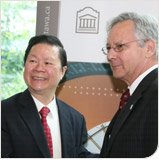
Next, on August 28, 2007, came a letter from the University of Ottawa’s Legal Counsel (Michelle Flaherty). This letter is posted HERE and states: “the University of Ottawa hereby requires that you immediately remove the images of Tabaret Hall, of the President of the University of Ottawa with Mr. Telfer and of the President of the University of Ottawa and Mr. Lau from the U of O Watch blog site … If you fail to remove these images by August 31, 2007, the University of Ottawa may take whatever action it deems necessary to protect its intellectual property rights.”
.
The Flaherty letter explained that it is University policy that the images “may be used by faculty, staff, students, and the news media solely for the positive promotion of activities related to the University of Ottawa.”
.
Having been informed of the University policy, Rancourt responded by making more widespread use of copyrighted University images, which greatly enhanced the blog.
.
The Dean of the Faculty of Science, André E. Lalonde, next enthusiastically took on the job of “protect[ing] [the University’s] intellectual property rights.” The Dean initiated his own investigation on November 23, 2007 (see letter posted HERE). In his letter, the Dean explained “I am concerned that your refusal to remove the copyrighted images from the U of O Watch website constitutes insubordination.”
.
What followed was a long series of meetings, exchanges of letters, and procedures (see Rancourt’s brief HERE for a summary) in which Rancourt tried to explain to the dean that both criticism and allowing criticism were positive and that, consequently, the University policy was not being violated.
.
The Dean disciplined Rancourt and warned of more discipline if the images were not removed. The Dean then appealed to the good judgement of VP-Academic Robert Major to ask that Major schedule the continuation of the investigation in order to pursue a suspension of Rancourt. Major obliged – leading to the present evaluation by the Board.
.
The Executive Summary of Rancourt’s BRIEF to the Board reads as follows.
.
The University of Ottawa has a stated policy of allowing professors to use its copyrighted images from its web site “for the positive promotion of activities related to the University of Ottawa.” (See Legal Counsel’s letter to Denis Rancourt dated August 28, 2007.)
.
Denis Rancourt uses credited copyrighted images from the University’s web site in the UofOWatch blog that he manages (see attached item-1).
.
The UofOWatch blog features commentary and critical articles about activities of the University of Ottawa (see attached item-1).
.
The credited copyrighted images from the University’s web site significantly enhance the UofOWatch blog (a picture is worth a thousand words) and show a positive image of a university open to self-criticism.
.
University professors have academic freedom in their research and communications, including in criticisms of the university itself. The university has a duty to support the work of its professors, within the usual limits of resource constraints.
.
The University has disciplined Professor Denis Rancourt (Letter of Reprimand dated February 5, 2008) for not removing the copyrighted images from the UofOWatch blog.
.
Dean André E. Lalonde presently seeks further discipline (a one-day suspension) to be approved by the Board, before a grievance (filed on February 24, 2008) against the first discipline has been heard.
.
The University’s discipline and the on-going attempt to further discipline are not legitimate and appear to constitute attempts at ideological (political) censorship. The actions of the dean (and of Legal Counsel) appear to be petty and contrary to fostering a vibrant and critical university intellectual environment in a free and democratic society.
.
In addition, there are many procedural anomalies that point to serious problems in ethical and responsible management. These include illegal gathering and use of personal information and unwarranted legal threats.
.
In wrapping up his BRIEF, Rancourt states:
.
“Criticism is positive, healthy, and necessary to produce change. Congratulatory niceties only support the status quo. Not exposing known problems encourages their continuation. Criticism is vital work that needs to be encouraged rather than censored and attacked.”
.
Let us hope that the Board, in its collective wisdom and mandated fairness, will find a way to celebrate freedom of expression and inquiry at the University of Ottawa.
.
[Photo Credit: University of Ottawa. Mr. Marc Jolicoeur, BLG Partner and Chairman of the University’s Board of Governors.]

Saturday, July 19, 2008

Arbitration Ruling Makes Academic Squatting Legal in Canada


On June 25, 2008, Arbitrator Michel G. Picher released his 65-page ruling in the matter of the University of Ottawa vs. the Association of Professors of the University of Ottawa (APUO) regarding Professor Denis Rancourt’s discipline grievance related to the Fall 2005 offering of the course PHY 1703 “Physics and the Environment” (Physique et environnement), popularly known as the Activism Course.
.
The University had taken disciplinary action against Professor Rancourt charging that he had misrepresented his course in a detailed web posting, in such a way as to have described a dramatically different course not compatible with the official course description. The Arbitrator rejected the University’s charges, finding that the described course was within the purview of academic freedom.
.
The then dean of the Faculty of Science, chemistry professor Christian Detellier, had barged into the classroom on September 21, 2005, to suspend the course, causing a strong student reaction that was amply reported in the media. The University has since apologized for the Dean’s in-class intervention: LINK.
.
The public arbitration hearings were held in Ottawa on November 5, 8, 14, and 26, 2007. The Arbitrator refers to the Activism Course in his decision as having been made “something of a ‘cause célèbre’” (p.27 of the June 25th decision).
.
The ruling is a landmark award that strengthens and broadens the scope of academic freedom in Canada. The full text of the Award is available HERE.
.
The ruling establishes that pedagogical innovation and implementation are fully protected under the academic freedom enjoyed by a professor, including the choice of grading system – considered an integral part of the pedagogical method.
.
In the specific case, the protected pedagogical innovations included:
.
(a) A large fraction of the class time used to present societal and political material – in a physics course intended to deliver fundamental physics concepts as the only required physics course in an environmental studies program – as a way to motivate student learning and to position the science in the broad societal context. This was achieved using invited scientist and non-scientist speakers that included activists, politicians, community workers, etc. The ruling clarifies that no “exception [was] taken to the use of activism and social and political issues as catalysts to learning.
.
(b) Parallel student workgroups with evolving themes and freely changing student memberships and town-hall-style whole-class discussions instead of traditional lectures delivered by the professor.
.
(c) An open invitation to all community members to freely and fully participate in the class, without necessarily officially registering and paying tuition, as a way to bring in the community to enrich class discussions and strengthen relevance and community connections. This brought in a variety of perspectives and expertises that would otherwise not have been available.
.
(d) Large latitude in individual student decision making regarding: order in which to learn things (e.g., workgroup membership and topic), depth of treatment, method of study, method of reporting progress, degree of cooperative work, etc. (Sharing was not considered cheating.)
.
(e) A satisfactory/non-satisfactory (S/NS) grading system rather than the traditional letter grade system (used in all other science courses given that term).
.
Having examined the long list of University complaints about how Professor Rancourt had, in his web communications (see ruling), subverted the “spirit, content, and function” (translated from French) of the course, the Arbitrator found that “that position cannot be sustained by the Arbitrator” and that all the innovations communicated and implemented by Professor Rancourt fell within his rights under academic freedom.
.
The ruling therefore again puts to rest the backward notions that hard sciences must be studied in isolation and that tunnel-vision specialization is the only acceptable way.
.
The Arbitrator added: “… the major change being with respect to the pedagogical innovation of independent group studies, the involvement of the students themselves in identifying areas of interest and the introduction of the satisfactory/not-satisfactory grading system. The Arbitrator is satisfied that those pedagogical initiatives were legitimately within the purview of the academic freedom enjoyed by Professor Rancourt …
.
The ruling therefore also lays to rest the doctrinal view that only grades can motivate students in the hard sciences and that students must be “forced to learn”, least our technological society fall in ruin. LINK. (If that is true, then Canada’s new academic freedom is indeed a dangerous freedom.)
.
In addition, the Arbitrator’s award also affirms that (consistent with actual practice) a course can, through a process of pedagogical choices, be significantly different in its use of class time and in topics covered than a literal and restrictive reading of the official (Senate-approved) course description would suggest: How much class time a professor chooses to use on what is a matter of pedagogical freedom, in the professor’s attempt to achieve the best possible end results; keeping in mind a professor’s right to be political in the classroom, as already well established in Collective Agreements across the country and in past rulings.
.
In the words of the Arbitrator, “The assertion … to the effect that the publicized descriptions of the course contained a ‘radically different content’ as compared to what was contemplated in the official description of the course cannot be sustained by the Arbitrator” and “there is simply no equitable basis upon which the University, or Dean Detellier, could assert … that Professor Rancourt ‘…brought major changes to the content of his courses…’ (Arbitrator’s translation) … the evidence before this tribunal confirms that … [the changes] fell legitimately within the scope of his academic freedom in pursuing a different pedagogical approach …” (p.60-61 of the decision).
.
The Arbitrator’s ruling is in sharp contrast to Professor (on leave) Christian Detellier’s hearing statement that “‘squatting’ is not an appropriate means to implement curriculum change within a university” (p.19 of the decision).
.
Professor Rancourt won the decision on every major point. Even on the minor point of the course title, the ruling explicitly established that a professor can describe his course with a dramatically different title: “Activism Course: Understanding Power and its Contexts” (web call-out) versus “Physique et environnement” (official Senate-approved title).
.
If your conclusion is “In the classroom, the students and professor rule!”, then you get an S for satisfactory, and you deserve an A+. Let’s make our education…
.
Epilogue: Legal Counsel for the University, Michelle Flaherty, apparently quit or was fired some months after the hearings, leaving her voice-mail greeting on the University phone for a week or so after she left; and without any official announcement of thanks or recognition or acknowledgement of departure from the University, leaving the position vacant to this day. Legal defence for the APUO was assumed by labour lawyer Sean T. McGee of Nelligan O'Brien Payne, who built the case around the principle of academic freedom. Christian Detellier went on academic leave for two years in 2006 before going back to being a regular professor in the Department of Chemistry. The Faculty of Science is on its fourth dean or interim-dean since 2005 (one died of cancer). Dean André E. Lalonde is presently the University’s defender of academic freedom in that faculty and is actively pursuing Professor Rancourt for alleged departures from the official course description in SCI 1101, Science in Society, Fall 2006, and for the professor’s teaching methods and grading practices in PHY 4385 and PHY 5100, Solid State Physics, Winter 2008.
.
LINKS

Monday, April 7, 2008

Discrimination at York University


The Ontario Human Rights Commission (OHRC) has recently completed its Case Analysis Report, in the case of Professor David F. Noble versus York University and Robert Drummond, Lorna Marsden, and Patricia Bradshaw, in the matter of "the respondents afford[ing] privileged accommodation to Jewish students at the respondent university (York) with regard to observance of religious holidays."


The Report's conclusion is unambiguous: "The university's practice of not scheduling classes on Jewish high holy days clearly results in differential treatment on the basis of creed, in that individuals in one group (those of Jewish faith) are given preferential treatment over others."


The full report is available HERE.

Monday, March 17, 2008

Oli Cosgrove to Minister of Education - UofO Campus Arrests

January 10, 2008
The Hon. John Molloy,
Minister, Training, Colleges & Universities,
900 Bay Street,
3rd Floor,
Mowat Building,
Toronto, ON M7A lL2.
.
Dear Mr. Molloy,
.
I’m writing to express to you my worry and disgust at attitudes and actions on the part of the University of Ottawa’s Executive that have recently come to my attention.
.
Firstly, at the Executive’s instigation, police arrested three Ottawa residents on the university’s campus early last December. The two women and one man had attended a public Faculty of Science Council meeting there last May in support of a second year for an activism course. The university allowed the course’s first year only after nine months of intensive lobbying. After the May meeting, the three were served with trespass notices. That alone was an insolent act. However, it was unenforced until one of the three submitted an agenda item to the Faculty Council for a December meeting.
.
The women were arrested on campus on December 6. The man was arrested on December 8, told he was trespassing on private property, and was escorted off campus in his wheelchair by three City of Ottawa police officers and several University security guards. He had offered to leave before the police arrived but was restrained so police could serve him with a summons. He is to appear in court on January 31. At least one of the women has vowed to take the matter to the Supreme Court, if necessary.
.
The attached article provides further details on this matter. [See LINKS below.]
.
Since when, Mr. Molloy, are universities, supported by public funds, private property? And, if public meetings are held on campus, how is a member of the public to know whether they are or are not allowed to attend them; whether they will or won’t be served with trespass notices should they attend them?
.
Furthermore, these arrests blatantly contravene the University’s “Vision 2010 Academic Strategic Plan.” In ‘Our Vision” under that plan, the University states that it is “an integral part of its community, open to the world, and distinguished by … its high-quality learning environment, its passion for knowledge and innovation …. its openness to diversity ….”
.
My second concern: the University’s Executive seems determined to eliminate Ottawa Cinema Politica (OCP), a Friday evening film course open to the public, given by Professor Denis Rancourt. I attend as many of these evenings as possible, there is seldom an empty seat, and sometimes there is standing room only. The Executive has tried before on false pretexts to put a stop to them. It is trying again, this year by claiming that the sessions are not part of Prof. Rancourt’s workload.

Either the Executive can’t read, has no memory, or has ulterior motives for its actions because these sessions have been repeatedly included as part of his workload in Prof. Rancourt’s annual reports and in other official past records. Additionally, it is part of a professor’s responsibility to provide community service, and Prof. Rancourt is committed to these sessions.

Up to now, the University has always provided an auditorium and projection equipment for these sessions. Now, however, it has made the auditorium difficult to book, and has refused to provide sign language access for the deaf community members, contravening the Ontario Human Rights Code.

This second heavy-handed action on the part of the University Executive again contravenes the University’s Vision 2010. In “Our Values” under the plan, the University states that it “values its community … encourages freedom of expression in an atmosphere of open dialogue, enabling critical thought, supported by intellectual integrity and ethical judgment.”

It is my observation, Mr. Malloy, that University President Gilles Patry and his Executive are trying to dictate which courses can and cannot be offered, and who can and cannot attend them. These actions of theirs make a mockery not only of the University’s Vision 2010, but also of the whole purpose of a university. It appears to me that the President and Executive are, therefore, unfit to head up any academic institution, particularly one supported by tax dollars.

I hope, Mr. Minister, that you will investigate these occurrences at the University of Ottawa. I know only of the incidents which I’ve mentioned here, but there may be others like them. We cannot allow leaders of our academic institutions to practice even the slightest repression of academic and civic freedoms. Apart from the repression, what sort of example does it set for our youth? Do we want them graduating with the impression that repression and dictatorship are acceptable?

Yours sincerely,
_____________
Oli Cosgrove

cc: Mme. Madeleine Meilleur
Prof. Denis Rancourt
The Ottawa Citizen
The Ottawa Sun
LaPress

Enc: letter to President Patry
article by Prof. Rancourt

LINKS
.
[Photo credit: From Minister's government web page.]

Thursday, March 13, 2008

Dean Gary Slater Reads Contempt


March 13, 2008

Gary Slater
Dean
Faculty of Graduate Studies
University of Ottawa

Re: Your letter about me to Dean André Lalonde dated January 29, 2008.

Dear Dr. Slater,

In your letter of January 29th to the dean of the Faculty of Science you complained about my late cancellation in serving as a thesis examiner on a student’s MSc thesis.

These were exceptional circumstances. I explained the circumstances to those making the thesis defence arrangements and the defence proceeded without negative consequences to the student.

It is your duty to act in such a way as to ensure optimal functioning of graduate programs, however, in your letter you allowed yourself to gratuitously conclude that “This behaviour [of my having to cancel an engagement due to unforeseen circumstances] shows contempt for the rights of students”.

That is an unacceptable statement from you about my character; that is not based on the facts of the matter and that is inconsistent with my professional ethics of the last 22 years.

I find your communication to the dean of Science in this regard to be unprofessional and unethical, unless you have discovered a magical gift for extrapolating into the heart of a person using only circumstantial administrative events.

I ask that you apologize to me and that you rectify your letter to the dean of Science by March 20th. I make my request public in an effort to discourage the use of such internal administrative documents such as your letter that gratuitously disparages a member of the university community.

Sincerely,

Denis Rancourt
Professor of Physics

cc: APUO
cc: dean of Science
cc: made public, media

[Photo credit: University of Ottawa.]

Saturday, March 1, 2008

Censorship is a serious matter – explains Professor Keith Benn


Professor Keith Benn (Earth Sciences, University of Ottawa) has recently joined Professor Jeremy Kerr (Biology, University of Ottawa; see PREVIOUS POST) in attempting to protect the University of Ottawa from out-of-control radical professor Denis Rancourt (Physics, University of Ottawa).

Benn “take(s) serious offence” at Rancourt’s November 30th 2007 email accusation of censorship practiced in the Faculty of Science. Dean of the Faculty of Science André E. Lalonde immediately responded in accordance with the responsibility of his position by initiating yet another formal disciplinary investigation of Rancourt in this serious matter. (We’ve lost count of the number, but it’s well over a dozen.)

All relevant documents (Dean’s initiation of discipline, Benn’s formal letter of complaint, Rancourt’s November 30th email, and the censored document) are posted HERE or HERE.
.
Highlights of the Benn complaint are as follows.
.
I take serious offence to the accusation of censorship that is contained in the following passage […]
.
Rancourt must know that the term ‘censorship’ is a highly charged one that carries some awful baggage in the public psyche. Tossing about accusations of administrative censorship in widely circulated emails [to members of the Faculty Council] […] is reckless and reprehensible, and shows a profound lack of respect for our institution and for our colleagues. It is especially troubling that such an accusation should be made within our University [Canada’s University] and it is unacceptable that it go unchallenged. If such an accusation should go unchallenged then the clear message […] is that the accusation has merit, i.e., that discussion of important issues facing our Faculty and our University are being suppressed.

Benn continues: “Rancourt’s accusation of censorship, if unchallenged, could do long-term damage to the reputation of our institution.

[…] if the accusation were found to be unjustified, then Rancourt should apologize to his victims. […] At the very least, an apology from Rancourt should be forthcoming and recorded in the public record.

UofOWatch vows to record any such apology when it is forthcoming, to help rectify this violation of the public trust.

UofOWatch trusts that the Dean’s investigation will be thorough and professional, will leave no stone unturned, and will establish whether or not censorship was indeed practiced in the Faculty of Science, as brazenly reported by Rancourt.

Censor n. 2. official with power to suppress whole or parts of records/documents on ground of obscenity, seditiousness, etc. 6. v.t. act as censor (sense 2) of; make deletions or changes in. (Concise Oxford, Seventh Edition)

RELATED LINKS

Saturday, February 23, 2008

Professor Jeremy T. Kerr defends the University of Ottawa


While some have complained that tenured university professors too rarely speak out to correct injustices in our society, Professor Jeremy T. Kerr (Biology, University of Ottawa) has recently provided a striking counter example.

Professor Kerr has written a strong formal letter of complaint against radical professor Denis G. Rancourt (Physics, University of Ottawa) to the dean of the Faculty of Science André E. Lalonde.

The dean, in turn, has used the letter to open a formal disciplinary investigation of Rancourt, thereby assuming the responsibility of his position in protecting the University.

If such a category existed, Rancourt would certainly hold the Guinness World Record for the most disciplinary investigations against a tenured university professor. This alone demonstrates the degree to which Rancourt is a menace to society.

Kerr’s letter, the dean’s letter initiating the investigation, and the main exhibit are posted HERE.
.
Highlights of the Kerr letter are as follows.
.
Kerr considers Rancourt’s recent open letter to President Gilles Patry (emailed to all professors; pages 3-4 HERE) entitled ‘Executive-ordered campus arrests of community members’ to be a “form of harassment” (against Kerr).

Kerr is concerned that Rancourt’s mailing appears “to waste university network resources”. (Especially if everyone were to print it out, we guess.)

Kerr states “[…] Furthermore, the dripping contempt to which he (Rancourt) routinely exposes his colleagues seems to be irreconcilable with the provisions of the Collective Agreement […]

Kerr continues, “Professor Rancourt’s routine misrepresentation of events cannot be viewed as consistent with any commonly accepted norm of fairness or ethical behaviour. Certainly, his constant disruption of even the most routine matters is beginning to make it difficult to function at the University of Ottawa and I worry this may diminish my capacity to fulfill my workload responsibilities.

Professor Kerr is clearly doing everything he can to ensure that university resources are spent to optimally benefit society. It is comforting to see that the university administration is enthusiastically taking up the challenge proposed by Kerr. When activist professors and the university leadership work together in this way, one can be confident that results will follow.

We trust that the dean’s investigation will corroborate all of Professor Kerr’s statements and help to relieve the professor of the strenuous conditions to which he has been subjected.

RELATED LINKS
.
MEDIA RESONSE TO THIS POST
.
[Photo credit: University of Ottawa]

Monday, January 28, 2008

Christian values do not apply to the Deaf, decide U of O executives


THE ACT AND HUMAN RIGHTS VERSUS REALITY


The University of Ottawa Act 1965 states that “The objects and purposes of the University are, to promote the advancement of learning and the dissemination of knowledge … in accordance with Christian principles … and to promote the betterment of society …”

It is of interest to compare these legal and moral obligations to actual decisions made by the University’s Executive. In some cases the obligations of the Act are augmented by explicit requirements of the Ontario Human Rights Code.

Let us take the recent example of a denial of access to the Deaf community that was reported in the media HERE (in English) and HERE (in French).

The event in question is a weekly documentary film and discussion series organized and moderated by physics professor Denis Rancourt that has operated continuously during the academic year since September 2005. (See schedules posted HERE and HERE.)

THE FILM SERIES IS A UNIVERSITY-SPONSORED EVENT

The campus auditoriums for the film and discussion series and the projection equipment have always been provided by the University, free of charge, including for the present winter 2008 season. Outside groups and official student clubs and associations, by comparison and without exception, must all pay significant fees to reserve rooms and use the projection equipment for non-University-sponsored events (e.g., HERE).

The film and discussion series has always been part of professor Rancourt’s yearly reports and has always been part of his official workload, under the universally recognized and established work category “community service”. Rancourt’s yearly reports have always been approved, in all his years at the University since 1987.

The valid work categories for professors include: research, teaching, administration, and community service. Academic freedom, which is protected by law, gives professors the right to freely choose which research and community service they do. For examples of sponsored research and community service activities see Rancourt’s official university web page: http://www.science.uottawa.ca/~dgr/.

Professors are entitled to request redistributions of their work among the different work categories. In winter 2006 Rancourt asked that his significant involvement with the film and discussion series be considered in possibly reducing his formal teaching duties. See the text of his application HERE.

All such requests, every year, follow strict procedures enforced by the Collective Agreement between the University and the professors’ union. Following established procedures in his department (the Physics Department, in the Faculty of Science), therefore, Rancourt’s request was first studied by the Departmental Teaching Personnel Committee (DTPC). Formal minutes record all DTPC meetings; that are chaired by the chairperson of the department. The chairperson forwards the DTPC recommendations to the dean of the faculty and adds the chairperson’s own recommendations. Then the dean makes the final decision about the professor’s workload for the upcoming academic year, without interference from the upper administration.

All usual records show that the required process was followed in winter 2006. Rancourt’s request to have a reduced formal teaching load was denied. The dean of the time, Christian Detellier, later confirmed in writing that, nonetheless, the film and discussion series remained part of Rancourt’s official workload under “community service”. See Detellier’s letter HERE.

Given the above described record and established and binding administrative procedures, there can be no doubt that the film and discussion series was and is an integral part of Rancourt’s official university workload and that it is a University-sponsored event, paid for and organized by the University, on its campus.

DEAN AND PRESIDENT CANNOT REDEFINE WHAT IS AND IS NOT

The Dean cannot unilaterally decide on a whim to suddenly change a professor’s workload, except under special resource-management emergency conditions and following special procedures. Likewise, a member of the upper executive, such as the President of the University, cannot intervene in defining a professor’s workload. (See Collective Agreement, section 22.)

Yet as early as 2007 the new dean of the Faculty of Science, André Lalonde, instructed the University computer services director that Rancourt should not be given electronic listserve messaging services for the film series because the dean did not consider the series to be a valid Faculty of Science offering. This type of petty in-fighting was only a precursor of what was to come.

When member of the Deaf community Genevieve Deguire asked the Access Service of the University for access (i.e., sign language interpretation services) to attend the film and discussion series she could not have expected the degree of resistance that she was to experience.

The university Access Service office directed Deguire to ask the professor in charge (Rancourt) to secure a memo from his dean that the series was indeed a Faculty-sponsored event. The Dean refused and it was claimed in writing that the film and discussion series was not part of Rancourt’s workload. Access Service is under the Student Academic Success Service (SASS). The director of SASS of the time, Serge Blais, sided with dean Lalonde in denying access, despite Rancourt’s clear explanations of the situation. See exchanges of emails HERE.

Deguire wrote to President Gilles Patry to ask that he repair the situation and provide access. Patry refused, citing Blais’ decision letter. See exchanges HERE.

At about this time the Access Service office booked a sign language interpreter by “mistake,” as they normally would have done without the dean’s negative response. As a result, Deguire and another member of the deaf community enjoyed one film and discussion event that was a great success. This confirmed to those in attendance that deaf community access was a benefit to all, including the hearing community.

Deguire therefore wrote the president a second time asking him to reconsider his decision. The President refused again. See exchanges HERE.

When the university called a December 2007 town hall meeting with its executive, Deguire asked to attend and was provided access to the meeting. At that town hall meeting Patry publicly stated that access to the film series would not be granted because the series was sponsored by a separate organization and was not affiliated with the University. He stated as “proof” that if an auditorium had not been available for the series then it could have been given off campus.

DEGUIRE GOES PUBLIC AND THE UNIVERSITY SPELLS IT OUT

Deguire held a well organized press conference on January 14, 2008, with virtually every major Deaf community association present in support, and with two sign language interpreters on hand, provided by Deaf community associations. The press conference was held in the lobby of the campus building (MacDonald Hall) where the film series has most often been hosted. Deguire filed THIS Ontario Human Rights Commission complaint.

The University made its position public. It put out THIS press advisory stating that the film and discussion series “is in no way related to any academic or other activity at the University of Ottawa.” Someone should inform the many professors who regularly attend and who recommend it to their students…

University Legal Counsel, Michelle Flaherty, is quoted by the media as stating that the film and discussion series, that has recently called itself the Ottawa Cinema Politica (OCP) series, is sponsored by Cinema Politica. That it is therefore not a University-sponsored community service and that, therefore, the University has no human rights legal obligation to provide access.

The university position, in the opinion of UofOWatch, is more tenuous than if it were to say, for example, that the U of O business school calls itself the Telfer School of Management and the university has received $25 million from Telfer towards the school’s new building so the university has no liability insurance responsibilities towards students of the school.

Cinema Politica is a shoestring-budget student network that started at Concordia University in Montreal and that provides a web site for promotion of film events put on by its independent name-affiliated members. It makes itself available as a free resource to organizers, including university professors, and it mostly serves university venues.

The University’s position is ludicrous and appears to be a device intended to deny access. The university pays for the auditorium, the projection equipment, the insurance coverage, security, after-hours auditorium wheelchair access via a lift operated by security personnel, and Rancourt’s salary. The university has given continuous public access to the weekly academic-year event since September 2005 and has never required that an external fee be paid by anyone.

To use such a device to deflect a modest request for access to a valued community educational experience is, in the opinion of UofOWatch, a violation of the historic principles guiding public academic institutions in Canada. This from a public institution that in the last fiscal year had a surplus of $67 million dollars and in the last year or so has received “no-strings-attached” private gifts of over $40 million dollars.

In the opinion of UofOWatch, if this is not the result of gross institutional incompetence, then it points to malfeasance of office by several University executives and their professional agents, including the president.

The University’s decision to deny access is contrary to “promot(ing) the betterment of society” “in accordance with Christian principles.” (University of Ottawa Act, 1965) Something is amiss.
.
***
.
[Note-1: “In the opinion of UofOWatch” means “In the opinion of its editor and manager Professor Denis G. Rancourt”, as always in this blog.]

[Note-2: Interestingly, the University formally admits that this UofOWatch blog is part of Rancourt’s official university workload, since it is using labour law and internal discipline to attempt censorship, yet it has now arbitrarily declared the OCP film series that it houses and finances as not part of Rancourt’s university workload… How convenient.]

[Photo Credit: The Fulcrum.]

Monday, December 31, 2007

Friends of Burma Requests that Ottawa U revise wall panel dedicated to Paul Desmarais


(Press Release, Ottawa, Canadian Friends of Burma, December 11, 2007)


The Canadian Friends of Burma urges the University of Ottawa to immediately revise the huge wall panel dedicated to the life and work of Paul Desmarais located on the university campus. The University must include information regarding Mr. Desmarias serving on the Board of Directors of Total, the French energy giant which operates a gas pipeline in Burma in partnership with Burma’s violent military dictatorship. The panel dedicated to Mr. Desmarais is on the ground floor of a new building at the university named after the billionaire. Mr. Demasrais, patriarch of the family that controls Power Corp donated $15 million to the University of Ottawa, the funds were used for the construction of the 12 storey Desmarais building.

Although the wall panel recounts in great detail Mr. Desmarais’s life there is no mention of his involvement with Total. Mr. Desmarias, served on the board of the French oil conglomerate from January 1999 till May 2002 when he gave his seat to his son Paul Desmarais Jr who continues to sit on the board. At present Power Corp. controls the largest shareholder in Total, Groupe Bruxelles Lambert (GBL) a Belgium based holding company that owns a 3.9% stake in Total.

Total is infamous for its operations in Burma in which it partnered with the Burmese military and UNOCAL to construct and then operate the Yadana natural gas pipeline. The Burmese military forcibly relocated villagers from their land to make way for the pipeline. During the relocation the villagers were raped, tortured and killed. The Burmese military forced villagers to construct infrastructure for the pipeline including helicopter landing pads and barracks for the soldiers.

Over the eight years that Power Corp has controlled the largest shareholder in Total, both the Desmrais family and Power Corp have repeatedly declined to comment on Total’s activities in Burma. Refusing to even acknowledge the controversy surrounding Total’s operations in Burma is an insult to the thousands of people in Burma who suffered greatly at the hands of Burma’s military government so Total could make a profit.

A French Parliamentary mission that investigated the pipeline concluded in October 1999 that

“The mission judges that the link between the military presence, the acts of violence against the populations and the forced labor is established as a fact. Total had to be aware of that fact.”

The Parliamentary Inquiry added

“It seems artificial to separate the construction of the pipeline which required the hiring of qualified labor and considerable technical means from the measures taken by the Burmese regime to ensure its safety. . . These security measures were what generated forced labor and population displacements in the area”.

A February 1st 1996 memo from Total Business Development Manager Hervé Chagnoux to UNOCAL substantiates the claim that Total paid Burma’s military to provide security and also suggests that Total was well aware of the use of forced labour,

“As far as forced labour used by the soldiers in charge of security on our gas pipeline project is concerned, we must admit between ourselves, TOTAL and Unocal, that we’re probably in a grey area.”

Natural Gas exports are by far the largest source of revenue for Burma’s military Junta. Total’s operations alone have annually provided the military dictatorship with hundreds of millions of dollars in revenue (some estimates are as much as US$450 million). Rather than spend the revenues on education or badly needed humanitarian supplies Burma’s generals continue to use their new found wealth to reinforce their own position by buying millions of dollars worth of weapons from China. These weapons are used to terrorize the population and kill scores of innocent people.

Nobel Peace Prize winner and leader of Burma’s democratic opposition Aung San Suu Kyi has repeatedly criticized Total for its harmful presence in Burma. She told Le Monde newspaper “Total has become the main supporter of the Burmese military regime.”

For a detailed description of the human rights abuses committed during the construction of the Yadana pipeline please read the 2000 Report issued by Earth Rights International called Total Denial Continues.

Also see the February 2005 Report by The Burma Campaign UK called “Total Oil: Fueling the Repression in Burma

------------------------------------------
145 Spruce St. Suite 206
Ottawa, ON K1R 6P1
Tel: 613.237.8056
Fax: 613.563.0017
------------------------------------------

UofOWatch Comment:

U of O President Gilles Patry’s astonishing response to a December 11, 2007, public request to acknowledge these facts is described HERE.

Given a second occasion to respond, Patry explained that the $15 million Desmarais donation was a “personal gift” to the university.

Paul Desmarais is a Companion of the Order of Canada and a member of the Privy Council.


“As a university we have an obligation to provide people with the skills and understanding they need to take their place in the world. Because of our unique position in Ottawa and in Canada, the University of Ottawa has an opportunity to cultivate leaders showing what true Canadian leadership looks like …”

[Photo: Detail of the Demarais bio wall panel in the Demarais Building, University of Ottawa.]

Saturday, December 29, 2007

U of O Apologises for Dean’s 2005 Outburst


In a classic case of a hierarchical institution’s suppression of an employee’s rights and freedoms, the University of Ottawa continues a campaign against Professor Denis Rancourt based on bogus disciplinary investigations and unfounded disciplinary charges.

To date this has included a dozen or so charges that have all been overturned, dropped, or grieved. Grievances typically take two years to be judged. Several of the early charges and their outcomes were reported HERE and HERE. The first grievance arbitration hearings were reported HERE. Some of the ancillary pettiness is described HERE.
.
It is therefore important to report the cases as they are concluded. The present report gives the final outcome concerning a dean’s 2005 in-class intervention that was at least partly motivated by Israel-Lobby sentiment: LINK.

In September 2005, at the second class of term, Dr. Christian Detellier, dean of the Faculty of Science, University of Ottawa, barged into physics professor Denis Rancourt’s Physics and the Environment course to cancel the class and supposedly to save the students from a perceived threat of great harm from being exposed to activism and to a democratic pedagogical method.

There was strong student protest against the dean’s action (SEE LETTERS), which lead to the class immediately being reinstated, as reported in the media: HERE and HERE.

Rancourt formally grieved the dean’s in-class intervention on October 12, 2005, thereby requesting an apology addressed to him and to all the students who were subjected to the disruption and an assurance that the university would take steps to avoid such outbursts by its executives in the future.

The grievance was followed by several contrived disciplinary attacks against Rancourt which were later dropped by the university despite Rancourt’s requests that they be pursued in order to clarify their merit.

The university fought the grievance for two years but then offered a settlement at the last hour, just before the hearings for another grievance case with Rancourt were about to commence. Had the university not settled, the dean’s in-class intervention would have been part of the investigation that was about to start on November 5, 2007. Consequently, the circumstances, impact, and nature of the dean’s in-class tantrum would have been more fully investigated and judged and could have had more significant bearing on the second case.

The university first tried to propose a secret settlement with a non-disclosure clause but this was flatly rejected by Rancourt’s union (the APUO) after Rancourt intervened. The dean’s in-class intervention had been a public display and the apology needed to be public.

A more suitable settlement text was negotiated between the university and the union. Rancourt rejected this text because it was not a strongly enough worded apology; it was not directed to the students, who suffered most of the consequences of the dean’s actions; and it did not present sufficient guarantees that this could not reoccur.

Despite Rancourt’s objections, the APUO ratified the settlement and justified their position to Rancourt as follows (in a letter from APUO’s president Atef Fahim):

“the Executive [of the APUO] felt that the employer’s statement reflects a commitment about interventions in the classroom that is beneficial to members generally, and does not imply that Prof. Rancourt’s specific situation justified intervention. It felt that the employer’s acknowledgement strengthens academic freedom. Clearly the employer is acknowledging that the classroom intervention was wrong. The employer’s statement is an admission of wrongdoing and a statement of regret over what they have done, and should be considered an apology.”

It appears we must conclude that the settlement is as close to justice as it is possible to achieve in the university context in practice. It also appears that deans don’t apologise to students.

It is interesting to contrast this settlement with the dean’s initial comments to the media that he “followed proper procedure” and that “a few, I can’t name you a number, but a few” students had complained about the course. The recent arbitration hearings established that there had only ever been a single student complaint and that the dean’s action was not based on this student complaint. Did the dean lie?

***

Back in 2005, at the third class of term, when the course (which was popularly known as the activism course) was reinstated and allowed to proceed as planned by Rancourt, a student asked dean Detellier if he had learned anything from the events which his actions had precipitated. Detellier replied that it was too soon to tell and that he would answer this question later. The dean never did answer the student’s question. Maybe now it would be possible to formulate an answer?
.
[Photo: Detail of a 20-metre wall poster made by the students of the 2005 course at an end-of-the-year party.]

Monday, December 17, 2007

Student Appeal Centre Report Exposes Systemic Abuse at U of O


The first ever report of the Student Appeal Centre of the Student Federation of the University of Ottawa (SFUO) gives the university administration and its executive an unqualified F.

The report was recently made public and describes a tyrannical administration imposing one-sided rules apparently designed to deprive students of both normal due process and unbiased treatment when contesting and appealing arbitrary and life-changing academic decisions made by professors, program directors, and deans.

In the words of the report:

“The most serious appeal cases are the ones related to intimidation, discrimination and unethical behaviour by professors or administrators […] Very rarely are these cases taken seriously nor are they handled respectfully.”

Place of higher learning? The report describes unimaginable regulatory circumstances that would be exemplary in a totalitarian state:

> complete absence of a policy against intimidation and (non-sexual) harassment of undergraduate students,

> professor’s testimony taken at its word versus required proof for student,

> strict deadlines at all stages for students versus no deadlines for the administration,

> cursory treatments and arbitrary case outcome decisions that depend more on who are making the decisions rather than the merits of the cases,

> a secret Senate Appeals Committee that will not identify its members or its chairperson, not even which academic units they represent, and

> terse final appeal decisions provided without documented rulings referring to the evidence or any indication of the grounds for the decisions.

Whereas 11 out of 15 recent cases to the Senate Appeals Committee were believed to be strong enough to win unambiguously, only 2 out of 15 cases won their appeals. The great majority of students, of course, do not take their cases all the way up to a final appeal, given the time, financial resources, and preparation that this requires.

All this is in sharp contrast to Canada’s university’s Vision 2010 mission statement and strategic plan which trumpets a “students first” self image.

The report concludes:

“For years, the Centre and its students have silently and obediently followed the rules and appeal process imposed by the administration. This simply does not work. It’s time for a change.”

The report is dedicated to the Centre’s students “who fought for fair treatment and who told us that ‘people have to know about this.’
.
[Photo credit: University of Ottawa]
.
RELATED

Friday, December 7, 2007

U of O limits access and arrests community members to block threatening agenda items


Today (December 6, 2007) campus democracy has attained new heights at the University of Ottawa.

Two community members were arrested and all community members and all non-Faculty of Science students were barred from attending a normally public Faculty of Science Council meeting so that certain agenda items would not be discussed.

The dean of the Faculty of Science, André E. Lalonde, has used a process technicality to motion offensive agenda items off the agenda. This Code Morin technicality, which allows a vote without discussion, is traditionally reserved to remove insignificant agenda items.

One agenda item in question, to create a second-year activism course, was significant enough for 300 students to sign a petition in its support, for the university to use City of Ottawa police “services” to arrest community members on bogus trespassing charges, and for all Faculty Council meetings in the last year to be cancelled over it.

Such is the twisted logic of a dean’s understanding of democracy and collegiality, at a university that, in its Vision 2010 mission statement, calls for increased community participation in its governance, and at which its president celebrates the importance of activism in his letters to community members condemning the cancellation of the popular first-year activism course.

So the dean has cancelled a fourth Faculty Council meeting in a row. As a result, there has not been a regular Faculty Council meeting in over one year and academic program development has come to a stand still.

A short history of cancelled meetings…

> April 5, 2007: Dean cancels meeting because student Council member Severin Stojanovic persistently complaints about dean’s illegitimate veto of his agenda item to consider approval of a second-year activism course. Meeting lasts 20 minutes.

> May 22, 2007: Dean cancels meeting because community member and independent reporter Karen Dawe refuses to stop video taping the proceedings. Meeting lasts 5 minutes. (Dawe was arrested by City of Ottawa police today, outside the Council meeting room.)

Stojanovic spearheads a campaign to have the Faculty By-Laws respected by the dean. VP-Academic, Robert Major, intervenes twice to claim that dean’s veto is legitimate. Administrative Committee claims that it has no power to force the dean to follow Faculty bylaws in running Council meetings.

> November 6, 2007: Dean cancels meeting after Stojanovic complains that proper process was not followed, that would allow new agenda items to be proposed. Meeting lasts 0 minutes.

Community member Jane Scharf legally submits an agenda item to discuss adding five community member representatives to the 40 or so member Faculty Council. The item is refuted without valid reason. (Scharf was arrested by City of Ottawa police today, outside the Council meeting room.)

New student Faculty Council member Daniel Cayley-Daoust submits an agenda item to discuss why the first-year activism course was not offered in the fall 2007 term.

> December 6, 2007: Dean has now added Stojanovic’s agenda item but the item is immediately motioned off the agenda as meeting begins. Stojanovic objects. Dean cancels meeting after Stojanovic refuses to leave the room. Meeting lasts 15 minutes.

Physics professor Denis Rancourt was to present the activism course item to Council and objected to this “dirty trick” being used to filter out unwanted agenda items (while being surprised that it took the dean eight months to decide to use a Code Morin procedural tactic to his ends rather than blatantly ignore the Faculty By-Laws). The dean would not let Rancourt make his point about misuse of the Code and instead asked Rancourt to leave. Rancourt used his academic collegial right to stay and make his point.
.

***
.
As the 2010 of Vision 2010 approaches at Canada’s university, we must wonder what the next Faculty Council meeting has in store for us. It does not look promising, as none of the tenured professor Council members saw anything anomalous in illegitimately invoking a Code Morin technicality to remove rather than discuss student and community supported agenda items…

Yet another milestone in applied democracy at the U of O!
.
[Photo credit: University of Ottawa]
.
RELATED AND FOLLOW UP: